















Ceremonial Sounds and Collective Experience
- Last Updated
- Published
- Category
- Sound
Have you ever noticed how rituals connected to spirituality and belief, whether passed down from ancient times or practiced today, often have sound at their core? This Wonderpost explores why sound has long been used as a medium in ritual and how it connects us to a shared sense of community.

If languages and cultures are shaped by the surroundings of a society, so are its sounds. The human voice was the world’s first musical instrument, used to tell stories and express feelings long before other instruments or sound recordings came into existence. Each community has its own unique singing styles and ways of playing music that reflect its identity. Often, sound is used for more than entertainment, from marking time and signifying social status to expressing grief or reflecting beliefs in its ability to heal physical and emotional illness.
Many communities around the world have made sound an inseparable part of their rituals. The vibrations of sound can help draw attention and bring groups of people together. Repeated vocalizations or rhythmic instrumentation can help reduce distraction and create a more focused state. In this way, sound plays an important role in guiding ceremonies, setting intentions and expressing meanings and emotions that words alone cannot always convey.

Let’s take a deeper look at how sound is used in rituals across different cultures.
In many cultures whose ways of life are closely connected to nature, there is a belief that sound can nurture relationships between ancestors, spirits, the land and the community. In Central Asia, Tuvan throat singing, which originated in the Republic of Tuva in southern Siberia, produces deep vocal tones at multiple frequencies simultaneously. These sounds often imitate elements of nature, such as water, wind and animals, and are used in rituals to communicate with spirits and the natural world, reflecting the belief that humans are part of the same whole.
Mongolia has Urtiin Duu, or the “long song,” a tradition passed down through generations that tells stories of nomadic life on the steppe. Through controlled breathing, singers sustain long notes across a wide vocal range in a free-form style, evoking the wind or echoes travelling across the grasslands. It is performed at weddings, housewarmings, Naadam and ceremonies welcoming new members of the community.

Across North America, Native American songs weave repeated vocals with breathing techniques to tell stories of nature spirits and ancestral memories. They accompany tribal rituals, healing practices and seasonal observances, each marking a different moment in the natural cycle. In spring, songs call upon the god of agriculture and ask for abundance in the crops. Summer brings the Sun Dance, honoring the sun and giving thanks for its life force and strength. In autumn, communities give thanks to the land for a plentiful harvest, while winter ceremonies honor rain deities and welcome the return of the sun around the winter solstice.
North Africa and the Middle East share the tradition of ululation, a high-pitched vocal expression created in the throat while swiftly moving the tongue, resembling a joyful howl. Often performed by women during birth ceremonies, weddings and celebrations, it can signify joy, emotional release and a sense of unity within the community. At funerals or during times of mourning, the vocal tone shifts to express grief.
What we cannot leave out is the role of sound in religion. Buddhism, in particular, has numerous sects across Asia, each using sound with different intentions.
In Theravada Buddhism, most familiar in Thailand and neighboring Southeast Asian countries, Pali texts are often chanted melodically, with monks traditionally relying heavily on memorization to pass these recitations down. They can tell Buddhist stories such as the Jataka tales, carry teachings from the Tripitaka, offer blessings and protective verses against illness and misfortune, or accompany auspicious ceremonies such as housewarmings and weddings. Chanting also plays an important role in funerals.

For other sects, such as Mahayana Buddhism in East Asia, chanting sutras and repeating mantras serve as both prayer and a practice for cultivating attention. Sound becomes a thread that connects the mind to the present moment, while controlled breathing brings awareness back into the body. In Vajrayana Buddhism across Tibet and the Himalayas, sound extends beyond chanting to include bells, drums and other instruments. Distinctive Ladakhi chanting follows carefully structured ritual forms that make Buddhist cosmology more tangible.
In Japanese Buddhism, chanting often draws from the sutras of each sect, exploring themes of emptiness, letting go, tranquility and meditation without elaborate storytelling. These chants are shaped to resonate with the temple’s interior acoustics and the rhythm of ceremonial practice, making the doctrine more accessible to those listening.
One of the most intriguing concepts can be found in Hinduism, where sound is understood as a sacred force and the foundation of the universe, as well as a path towards spiritual transcendence. Vedic mantras follow precise melodic patterns, while one of the most familiar sounds, Om, is often voiced before and after yoga practice. Traditionally believed to be the primordial vibration associated with the birth of the universe and connected to all life, chanting Om can be thought of almost like tuning an instrument, bringing breath, body and mind into harmony to create stillness and deeper concentration. Sound also appears throughout other religious traditions, from Gregorian chant in Roman Catholicism and singing in other Christian churches as a way of interpreting stories from the Bible, to the melodic recitation of the Quran during Islamic prayer.

When instruments are used in ceremony, each carries its own language. Some encourage inward reflection, while others serve a more ceremonial purpose. In Judaism, the shofar is sounded during Rosh Hashanah and Yom Kippur, marking sacred moments in time. Bells perform a similar role in Christianity, while percussion can help guide awareness during Zen meditation.
Many of these traditional uses of sound continue today. At the same time, alternative and New Age practices have emerged, drawing from different disciplines, religious beliefs and ancestral wisdom and bringing them together in contemporary ways. Some also look to scientific explanations to understand how sound interacts with the body. Sound begins as vibration at its source, causing molecules in the surrounding medium to compress and expand as energy travels in waves. As the body is largely made up of fluid, some contemporary practices suggest that these vibrations can create movement within the body, producing sensations similar to physical movement or exercise. Alongside other factors, sound can also influence heart rate, brain activity and how we feel.
Once we look beyond the frame of traditional ritual, we find unexpected connections between ancient beliefs and contemporary music. Andrew Weatherall, the producer behind Primal Scream’s masterpiece Screamadelica, became interested in the Cathars after organising the Convenanza in Carcassonne, France, a place closely associated with Cathar history. The festival takes its name from the ceremony the Cathars underwent when they committed to the faith. From there, he began to see acid house and related genres as deeply ritualistic, particularly in their ability to create moments of transcendence and mindfulness through repetition, intensity and euphoria.

Rave culture and clubbing can create a powerful sense of collective experience, sometimes amplified by psychedelic and other altered states. DJs can take on a role almost like a priest, guiding the collective through sound and rhythm. Yet here, the gathering happens on the dancefloor, where people who share a common passion come together and dance through the night, creating a continuous exchange of energy. In this sense, the modern dancefloor can echo the communal spirit of ceremonies from ancient times.

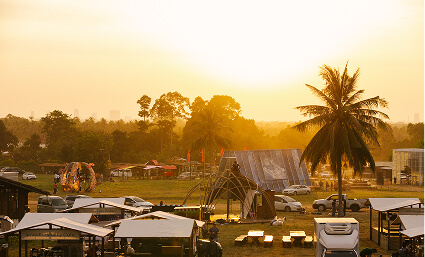
At Wonderfruit, ceremonial sound has always appeared in many forms, both traditional and contemporary. At Dhyana, our initiative in collaboration with Black Turtle, contemplative experiences rooted in traditional, community-centered wisdom explore sound as part of the practice. Wonderers can encounter a workshop inspired by dohas, songs or poems of realization expressed by great meditation masters. Ancient teachings are introduced through meditation and interpreted within a contemporary context, where wisdom is awakened through chanting, mantra, mudra and ecstatic expression. Meanwhile, Sounds of Sahajayana brings together chanting, sacred sound and meditative soundscapes with electronic beats, taking Wonderers on a deeper inner journey.
In Wonderness, you will find the workshop inspired by the Japanese practice of Tama Migaki, which means “polishing the gemstone of the mind.” Another experience draws from the Isan belief in Khwan, a vital essence believed to reside within all living beings and which, according to tradition, can sometimes wander away from us, leaving us feeling physically or emotionally unsettled. Singing and movement are used to call the Khwan home. Elsewhere, tachyonized instruments tuned to 432Hz offer another approach to relaxation and inward exploration.
Alongside music, ritual and ceremony-inspired acts unfold across many venues throughout The Fields. Shanka Tribe from Kerala, India, blends organic instrumentation with contemporary electronic textures, drawing inspiration from nature, indigenous traditions and global musical influences to create a sound that feels both grounding and transcendent. MONTAÑERA, a Colombian artist, brings together experimental electronics, ambient soundscapes and traditional Colombian music, inspired by the mountains, rivers and seas of Colombia, as well as the energy of Bogotá. Haedong Lee and Yidan Kim explore the intersection of olfaction and audition, merging sound, smell and ritual to investigate themes of sensory enlightenment. From Taiwan, Mong Tong draws on local myths through contemporary music, creating performances that evoke the mystery and atmosphere of a spiritual ritual.

We’ll also screen Geinoh Yamashirogumi, a documentary produced by Wonderfruit, at Baan Bardo. Directed by New Zealand filmmaker Nick Dwyer, the film explores the relationship between sound and ceremony through Geinoh Yamashirogumi, a multidisciplinary collective of more than a hundred members, bringing together not only trained musicians but also scientists, engineers, journalists, students and anyone drawn to the role of sound through the lens of ethnomusicology. At the heart of the collective is a strong sense of community, placing greater importance on coming together to “act, play and enjoy” than on being professional musicians.

Together, they stage Kecak, inspired by Balinese culture, which has grown into an annual summer festival held in the heart of Shibuya, Tokyo, for nearly five decades. Their performances bring together traditional instruments from different regions with choral voices, heard in Symphonic Suite Akira, the soundtrack to the animated film of the same name. Performed with remarkable clarity and precision, the music creates an almost trance-like experience. Through this work, the collective seeks to understand traditional music used in ancient rituals while exploring social and neurological experimentation powered entirely by human energy.

Here, regardless of the form a ceremony takes, sound acts as an important medium for bringing people together around shared beliefs, practices and interests. It speaks to something deeply human: the instinct to gather, participate and connect through shared experience, a behaviour that has been part of our collective nature since ancient times.
Further reading
Voices Without Borders: Exploring Vocal Traditions from the World’s Cultures — Sound Infusion
The Influence of Sound on Cultural Identity and Rituals — EGIN
Sacred Sound: Music as Ritual — Park West Strings
Sound, Ritual and Culture — Chakra Tones
Sound as a Path to God — Hinduism Today
Andrew Weatherall: The DJ and Disco Maverick — The Guardian
The Sonic Architects of Shinjuku: The Collective Vision of Geinoh Yamashirogumi — The Vinyl Factory
