


















Keeping our connection to wonder
- Last Updated
- Published
- Category
- Mind
In recent months, the world has felt less and less familiar. From the small screen of our phone, the world is reflected too often in scenes of fear and uncertainty.
As we try to find our footing, how do we encounter a stranger’s face and react with delight, instead of suspicion? How do we hold on to wonder?
If we walk a path back to the self, to ritual, to meditation, we may find the roots that ground us within—and to each other. And perhaps from this foundation, we can find wonder and joy in expression.

Finding refuge in presence
How do we find spaces of calm, when chaos is so often amplified in online echo chambers?
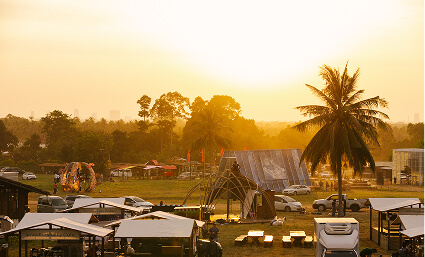
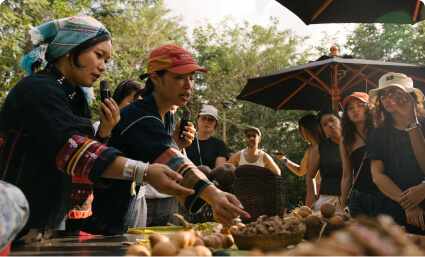
Recently, Dhyana’s curators and Buddhist art collective Black Turtle hosted a very small, intimate event at Baan Thewes. Supported by the multidisciplinary artwork of Emily Avery Yoshiko Crow, those who joined explored how and why we make offerings, with a reflection of what an offering might be.
If asked, Black Turtle’s Harry Einhorn might tell us that offering is already a universal practice. We are already offering our time, our attention, our efforts and our resources to each other in unseen ways. When we make offerings in a ceremony, it is a chance to reflect on that unseen and overlooked generosity, to approach it with renewed intention, warmth and generosity.
When we share in a ritual, whether it is sacred, spiritual or habitual, we agree to a certain shared intention. It is an agreement to respect the moment, to try to understand each other (or at least to honor each other) and to be joined in synchronicity.

Spaces (made from) human expressions
Scholars, scientists and anthropologists have argued at length about whether it is in human nature to sing, dance and make art. Whether it’s nature or nurture, we create as a form of communication. Spirited creation is humanity’s answer to despair. We believe it can serve another purpose—it is a common language we can all learn to speak, something we can all learn to listen to.

Each cultural expression is a gift made of what someone has felt at some point in their life. It carries with it markers of history, personhood, geopolitical context, happiness and grief. An ant-egg omelette found in Northeast Thailand is very much the same as kimchi jjigae: both are meals born of necessity, innovation in adversity that have become delicacies.
Most Thai cuisine isn’t meant to be eaten alone. Traditionally, a full meal consists of several dishes to balance the flavors, to present the sweet and the salty alongside the acid and the bitter, always eaten together with the whole table. So when we enjoy a local meal, we carry on traditions of community, collectivism and generosity, hidden between the lines of a recipe, passed down with reverence as one might preserve heirloom seeds.
Just across the border, traditional teahouses in Myanmar are a pillar of business and politics (albeit mostly for men), a place where decades of people would gather elbow-to-elbow to debate, socialize and broker deals. Myanmar’s relationship with tea is wound up in layers of symbols and context. Tea leaves—and the eating of them—have represented peace offerings, or even the acceptance of a judge’s ruling. All this history lives in every plate of laphet thoke and sugary cup of milk tea.
Molam music is often sung in Isaan dialect, played on instruments found all along the Mekong River, preserving and transmitting a reality where today’s borders didn’t exist at all. A Sufi love song might carry forth the words of a poet who never knew the demarcations between Iran, Pakistan and India. Each expression connects us to people not just from different cultures, but from different times.

Housed in community
At the end of February, we joined many others to commemorate Studio Lam’s Last Dance.
This marked the end of a long history as an institution in Bangkok’s underbelly of music. For several years, Maft Sai and Zudrangma Records have given niche artists and their fans a home—platforming genres from breakbeat DJs to molam to heavy metal bands headed by Thai youth. On its last night, Studio Lam’s extended family crammed inside its cozy space, bought each other pungent shots of yadong cocktails and warmed their bellies with street food-style fare from Wandering Kitchen.
Even if beloved locations close their doors, the connections formed between a community remain open. Memories of a community in celebration carves out a place where joyful expression is a shared reality, not some elusive creature. Joy is knowledge of oneself in a collective, in relation to other beings.
Each dance, each intimate performance, each moment of discovery and solidarity with underground artists continue to bind us together with a resilience greater than any four walls.

Softening the artificial walls of the mind
People with greater empathy are more likely to connect with the arts on a more emotional level. And yet art can elicit in each person a small transformation, depending on their own personal experiences and lens of how they view the world.
To engage with cultural expressions unfamiliar to us confronts rigidity. When asked to read a literary memoir by an undocumented immigrant or a news-style account on the same topic, study participants who read the literary work reported significantly higher levels of empathy. For some, this effect lingered even a month later.
The arts test the strength of imposed structure, while asking us to perform an intentional projection—an extension beyond the self. We learn a new feeling, a new sensation, a new thought, a reality that challenges our own. We unlearn that which confines us, that which no longer serves us, that which isolates us. Art asks us to use the underutilized muscle of empathy.
So what happens if we exercise this muscle more often? What if we learn to put ourselves in someone else’s shoes again and again and again? What if we have fun while doing it? Creating, sharing, living in art deconstructs learned hierarchy. Who is the master on the dance floor? No one: we all move together.
