












The many expressions of art at Wonderfruit 2025
- Last Updated
- Published
- Category
- Art
If asked, Bow Wasinondh, Senior Director of Arts & Culture would describe art and architecture that you see in The Fields as site-specific and community-specific. They respond to the shifting evolutions of nature and the cultures of Wonderers through the artists’ psyche and creative practices.
“Art isn't defined by a presenting medium or form," reflects Bow, "but rather in its intention and the creative language used to engage with the world."
Here are some of the creative languages our collaborating artists have spoken in:

Art, as made for community
Many of the installations—permanent, semi-permanent or ephemeral—also serve as spaces for people to gather, whether in rest or in ritual.
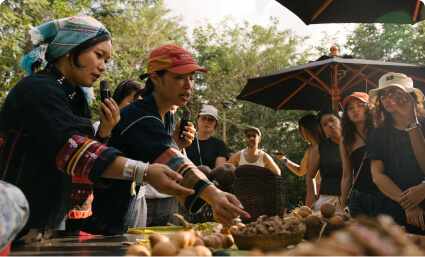
In the Ancestral Forest, brand new installations ‘Gathering Tables Wonderfruit’ were created by Pinaree Sanpitak to be used for nature-led programs connecting Wonderers with the natural world, through rituals of dining, botanical workshops and more. Natural stone bases connect directly with the ground, supporting stainless-steel tops where the artist’s hand engravings tell layered stories.
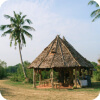
In contrast, ‘Embrace: Voices Above and Below’ by Hear & Found invites you into a glimpse of the world as experienced by the indigenous people who live in profound communion with the Earth. Originally a collaboration with Nanu Youttanakorn, it has evolved over the years. Once, this rammed-earth shelter amplified the voices and songs of tribes like the Karen, Hmong and Moklen. Now, we hear what they hear and inhabit the soundscapes they do, connecting us to the non-human world through geophonic and biophonic recordings.
Another structure crossing between art and architecture is designed for shared play. ‘BamBoom!’ by Bamboo Studio Thammasat is inspired by the spirit of cooperation of a carousel—a playground apparatus that rotates through collaboration. The brand-new bamboo installation is the result of a partnership between Wonderfruit, Bamboo Studio from Thammasat University and Giant Grass Design Studio, made into reality by architectural students.
And as a tribute to shared dreams, ‘Light Hive’ by RGB x RedLight Lab returns, extending its activities in celebration of a Decade of Wonder. Roaming pop-ups will appear in new places away from homebase, while on the last day, the project will capture a Wonderfruit family photo on the largest wet plate portrait ever made in The Fields.

Art, as dialogue with nature
The land is our greatest collaborator and source of inspiration. Nature makes itself known in pieces in unexpected ways, influencing and steering each artwork’s evolution.
When first introduced in 2018, the installations of ‘Island’ by Ruangsak Anuwatwimon were alienated from the tropical space around it. Growths within sculptural structures harvest moisture released from the ground, creating micro ecologies inside. Through time, Ruangsak’s work has effectively rewilded itself. Last year, one of the trees that sprouted through the artwork from inside had its branches snapped in a tropical storm, shattering part of the structure and leaving an opening for the branch to heal and resprout.
Meanwhile, the mirror mosaics of ‘Mindfulness Amidst Changes’ by Sanitas Studio draw closer to nature. In 2022, a brown salwood tree grew right beside the installation. Embracing the non-invitation, Sanitas built into the tree—and last year, added earth walling outside the glittering structure to invite further local plant species in.
Within ‘The Grower’ by Dusadee Huntrakul, there is always life hidden in the sculpture’s organically formed nooks and folds. A roster of critters and insects build cocoons in the bronze, casting webs and tracing colorful excretions amongst the trumpet-like mushrooms sprouting all over its body.

Art, to recontextualize space
One of the things art in The Fields asks is: can art be the medium that deepens how we see and feel our world?
Although innocuous, a shift in elevation has an effect on how we behave and how we feel. The modular, curving shapes of ‘The Walk’ by Boonserm Premthada have become an iconic landmark. A brilliantly colored, floating walkway, it encourages both motion and stillness, attracting people of all ages at different times of day. It reframes the grass beneath and the coconut trees that stand around it, allowing us to view The Fields from new vantage points.
Meanwhile, the thin walls of ‘Microtopia’ by TeaRoom create a pocket of Zen beneath a tree cluster. Its erected barriers are inspired by Japanese architecture that is designed more to lend context to a space than keep nature out, encouraging focus and respect to the ritual space. It’s a small world woven into The Fields, where experimental tea ceremonies are hosted in a microcosm of harmony.

Art, as a record of personal evolution
“Returning artists evolve in their participation,” Bow shares. “Their practices shift over time and are reflected in their continual work in The Fields.”
Tawatchai Puntusawasdi’s steel sculpture series ‘Contour Distort’ began as a cerebral, metaphysical project. Tracing a section around the body’s void, Tawatchai distorted the figurative outline into nearly-unrecognizable forms. Now, with the artist’s own spiritual journey from abstract to humanist, you can almost see the shift of the sculptures and their shadows as the most recent addition grew closer to a more identifiable bodily shape.
Evolving too this year is Satit Raksasri’s ‘Singing in My Mind’ (formerly ‘A Singing Sea’). Once, this piece spoke to pollution in our oceans, covered with discarded materials collected from the beaches and seas of Thailand. In December, the domed structure softens, welcoming Wonderers into its cocoon-like structure. Exchanging plastic waste for fabric off-cuts and found materials, the artist forms a patchwork tableau of human and non-human figures.
Discover more of the art and architecture in our Directory. To get the latest updates on Wonderfruit 2025 tickets, join the waitlist.
